Update · holidays
Holidays 2027 Pay Rules: DOLE Labor Advisory 17
Published on
Quick answer
The Philippines has 10 regular holidays and 8 special non-working days in 2027, set by Proclamation No. 1427, s. 2026. Under the holidays 2027 pay rules from DOLE, work on a regular holiday pays 200% of your daily wage, and work on a special non-working day pays 130%. DOLE set these rules in Labor Advisory No. 17, Series of 2026, dated 28 September 2026.
The proclamation was signed on 8 September 2026. Its full text is on LawPhil, a free law library, because the Official Gazette website does not open for automated readers. Our 2027 holidays page has the full list and the pay table in one place.
Which are the regular holidays and special days in 2027?
The proclamation lists 19 dates. Ten are regular holidays, eight are special non-working days, and one is a special working day.
| Date | Day | Holiday | Type |
|---|---|---|---|
| 1 January | Friday | New Year's Day | Regular holiday |
| 6 February | Saturday | Chinese New Year | Special non-working day |
| 25 February | Thursday | EDSA People Power Revolution Anniversary | Special working day |
| 25 March | Thursday | Maundy Thursday | Regular holiday |
| 26 March | Friday | Good Friday | Regular holiday |
| 27 March | Saturday | Black Saturday | Special non-working day |
| 9 April | Friday | Araw ng Kagitingan | Regular holiday |
| 1 May | Saturday | Labor Day | Regular holiday |
| 12 June | Saturday | Independence Day | Regular holiday |
| 21 August | Saturday | Ninoy Aquino Day | Special non-working day |
| 30 August | Monday | National Heroes Day | Regular holiday |
| 1 November | Monday | All Saints' Day | Special non-working day |
| 2 November | Tuesday | All Souls' Day | Special non-working day |
| 30 November | Tuesday | Bonifacio Day | Regular holiday |
| 8 December | Wednesday | Feast of the Immaculate Conception of Mary | Special non-working day |
| 24 December | Friday | Christmas Eve | Special non-working day |
| 25 December | Saturday | Christmas Day | Regular holiday |
| 30 December | Thursday | Rizal Day | Regular holiday |
| 31 December | Friday | Last Day of the Year | Special non-working day |
Regular holidays and special days, 2027, source: https://lawphil.net/executive/proc/proc2026/proc_1427_2026.html
Six of these days fall on a Saturday in 2027: Labor Day, Independence Day, Chinese New Year, Black Saturday, Ninoy Aquino Day and Christmas Day. For someone who works Monday to Friday, they give no extra day off. To compare with this year, see the 2026 holidays.
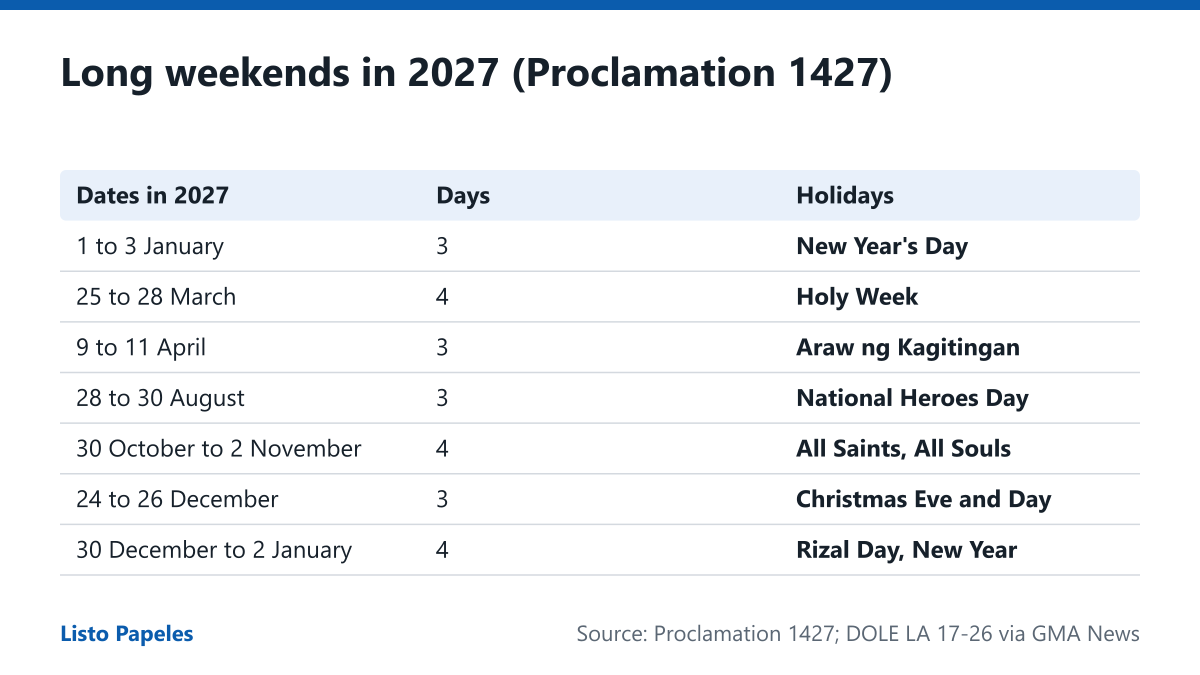
Which long weekends does 2027 give?
If you work Monday to Friday, 2027 has seven long weekends. Three of them last four days.
| Long weekend 2027 | Days | Holidays |
|---|---|---|
| 1 to 3 January (Fri to Sun) | 3 | New Year's Day |
| 25 to 28 March (Thu to Sun) | 4 | Maundy Thursday, Good Friday, Black Saturday |
| 9 to 11 April (Fri to Sun) | 3 | Araw ng Kagitingan |
| 28 to 30 August (Sat to Mon) | 3 | National Heroes Day |
| 30 October to 2 November (Sat to Tue) | 4 | All Saints' Day, All Souls' Day |
| 24 to 26 December (Fri to Sun) | 3 | Christmas Eve, Christmas Day |
| 30 December 2027 to 2 January 2028 (Thu to Sun) | 4 | Rizal Day, Last Day of the Year, New Year's Day 2028 |
Long weekends for a Monday to Friday worker, 2027, source: https://lawphil.net/executive/proc/proc2026/proc_1427_2026.html
The 30 October weekend needs no leave because 1 and 2 November are both special non-working days.
How much is holiday pay on a regular holiday in 2027?
If you do not work, you get 100% of your daily wage. To qualify, you must have worked or been on paid leave on the workday before the holiday. If that day is a non-working day or your rest day, the day before it counts instead.
If you work, you get 200% of your daily wage for the first eight hours. Each overtime hour adds 30% to the holiday hourly rate, which makes 260% of your normal hourly rate. A regular holiday on your rest day pays 260% for the first eight hours.
Example: your daily wage is ₱700 and you work eight hours on Bonifacio Day. You get ₱700 × 200% = ₱1,400. Our holiday pay calculator does the math for any wage and number of hours.
How much is the pay on a special non-working day?
The rule is no work, no pay, unless your company policy, practice or CBA says otherwise. If you work, you get 130% of your daily wage for the first eight hours. Overtime adds 30% to that rate, so 169% of your hourly rate. On your rest day, the first eight hours pay 150%, and overtime pays 195%.
| Type of day | Not worked | Worked | Worked on rest day | Overtime |
|---|---|---|---|---|
| Regular holiday | 100% (if you qualify) | 200% | 260% | 260% (338% on rest day) |
| Special non-working day | No pay | 130% | 150% | 169% (195% on rest day) |
| Special working day | No pay | 100% | 130% (Labor Code) | 125% |
Holiday pay rates as a share of the daily or hourly wage, 2027, DOLE Labor Advisory No. 17, s. 2026 (rest day on the special working day: Labor Code), source: https://dole.gov.ph/news/dole-sets-guidelines-for-holiday-pay-rules-in-2027/
These rates come from DOLE Labor Advisory No. 17, s. 2026, and they match our holiday pay rules guide. The advisory gives no separate rate for work on a rest day that falls on the special working day. The 130% in the table is the general rest-day premium of the Labor Code: 30% on top of the daily wage. DOLE also announced the advisory on its news page. For overtime on ordinary days, use the overtime pay calculator.
What about February 25, Eid'l Fitr and Eid'l Adha?
The EDSA People Power Revolution Anniversary on 25 February is a special working day. It is paid as an ordinary working day: no work, no pay. Overtime adds 25% to your hourly rate.
Eid'l Fitr and Eid'l Adha are regular holidays in 2027, but they are not in the table yet. Section 2 of the proclamation says their dates will come in separate proclamations once the Islamic calendar dates are set. Section 3 gives DOLE the task of issuing the pay guidelines, which it did with Labor Advisory No. 17.
This is general information, not legal or payroll advice.
Frequently asked questions
Is Chinese New Year 2027 a holiday?
Yes. Chinese New Year falls on Saturday, 6 February 2027, and Proclamation No. 1427 makes it a special non-working day. The rule is no work, no pay, unless your company policy or CBA says otherwise. If you work that day, you get 130% of your daily wage for the first eight hours. Because it is a Saturday, it gives no extra day off to people who work Monday to Friday.
Is Holy Week 2027 a long weekend?
Yes, and it is one of the longest of the year. Maundy Thursday (25 March) and Good Friday (26 March) are regular holidays. Black Saturday (27 March) is a special non-working day. With Sunday, 28 March, a Monday to Friday worker gets four days off in a row. If you work on Maundy Thursday or Good Friday, you get 200% of your daily wage.
When are Eid'l Fitr and Eid'l Adha 2027?
The dates are not set yet. Proclamation No. 1427 says both are regular holidays, but their dates will come in separate proclamations once the Islamic calendar dates are known. When the proclamations come out, the same regular holiday pay applies: 100% if you qualify and do not work, and 200% if you work. We add each date to our 2027 holidays page when it is proclaimed.
Do I get paid on a regular holiday if I did not work?
Yes, you get 100% of your daily wage if you qualify. You must have worked or been on paid leave on the workday before the holiday. If that day is a non-working day or your rest day, you must have worked or been on paid leave on the day before it. Our holiday pay rules guide lists the groups of workers who are not covered.
Is February 25, 2027 a day off?
No. The EDSA People Power Revolution Anniversary on Thursday, 25 February 2027, is a special working day. Offices and companies work as usual. It is paid like an ordinary working day, so no work means no pay. Overtime that day is paid at an additional 25% of your hourly rate, the same as on any ordinary day.
Was this page helpful?