Update · philhealth
PhilHealth Solo Parent Premium 2026: Government Now Pays
Published on
Quick answer
Qualified solo parents no longer pay their own PhilHealth premium. The National Government pays the PhilHealth solo parent premium under PhilHealth Circular 2026-0015, and for employed solo parents the change applies from October 2026. The employer still pays its own share, and the solo parent must file papers first because the switch is not automatic.
The rule comes from Section 12(c) of RA 11861, the Expanded Solo Parents Welfare Act. PhilHealth set the details in Circular No. 2026-0015, which updates Circular No. 2024-0020. It took effect when it was published in the Manila Standard on 26 September 2026, as stated in PhilHealth's own Tamang Sagot FAQ.
Who pays the premium of a solo parent now?
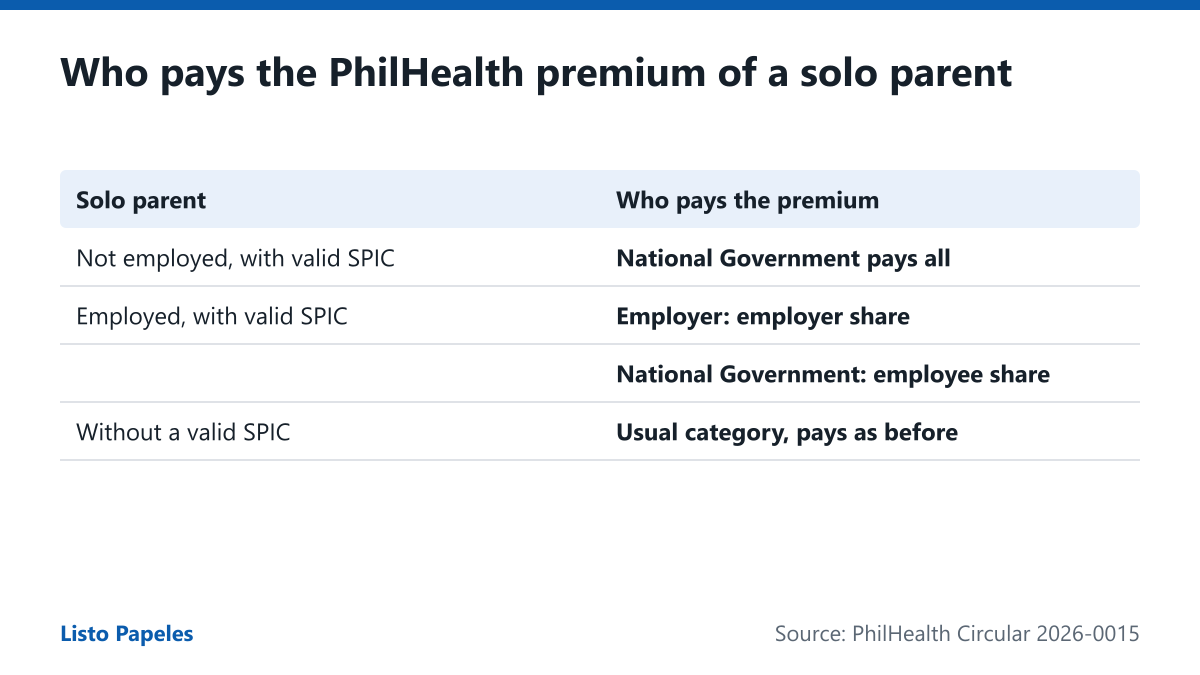
It depends on whether you have a job and a valid Solo Parent Identification Card (SPIC). Only solo parents with a valid SPIC are tagged in PhilHealth records as Indirect Contributor, with Solo Parent as the subtype.
| Solo parent | Employer share | Employee share |
|---|---|---|
| Not employed, with valid SPIC | Not applicable | National Government pays all |
| Employed, with valid SPIC | Employer | National Government |
| Without a valid SPIC | Usual category | Usual category, pays as before |
Who pays the PhilHealth premium of a solo parent, PhilHealth Circular 2026-0015, source: https://www.philhealth.gov.ph/circulars/2026/PC2026-0015.pdf
For an employee, the premium is still split in two halves. The employer pays its half as before. The other half, which used to come out of your pay, is shown as non-collectible from you. Our PhilHealth contribution guide and the PhilHealth contribution calculator show how big each half is for your salary.
If you are also a senior citizen, a person with disability or an indigent member, you keep that category. PhilHealth adds your SPIC number and its validity to your record so that your dependents aged 22 and below stay covered.
How do employed solo parents stop paying their share?
PhilHealth says the subsidy is not automatic. Your record must first be updated so that the employer's billing system sees your new status. These are the steps:
- Fill out the PhilHealth Member Registration Form (PMRF).
- Attach a photocopy of the front and back of your valid SPIC.
- Give both to your HR department. HR fills out the Employer Certification of Solo Parent Employees, which is Annex A of the circular.
- Your employer's PhilHealth representative (PEER) sends the papers to the nearest PhilHealth office.
If your employer does not do it, you can file the same papers yourself at a PhilHealth office or through the PhilHealth Member Portal. Once the record is updated, the employer's remittance system recognizes your status when it generates the Statement of Premium Account.
How do solo parents who are not employed register?
Go to the nearest Local Health Insurance Office. Our PhilHealth office finder lists branches by city. Bring a filled-out PMRF and a printed copy of the front and back of your SPIC.
The current PMRF has no box for solo parents yet. Until the new form comes out, write "Solo Parent" and your SPIC number just below the Indirect Contributor membership type in Part IV. Then wait for your Member Data Record and PhilHealth ID. Our PhilHealth registration guide covers the form, and the MDR guide explains how to check your new category.
A representative can file for you. They need a letter of authorization signed by you and one valid government ID with a photo of the representative.
If you are not in the DSWD Solo Parent Centralized Database, or you cannot show a SPIC, PhilHealth enrolls you as a Self-Earning Individual or as Financially Incapable, whichever fits. You get your SPIC from the Solo Parent Office or Division of your city or municipality.
Which dependents of a solo parent are covered?
All dependents listed on the back of your SPIC. They must live with you and depend on you, be unmarried and unemployed, and be 22 or younger. Those over 22 qualify if a physical or mental disability means they cannot fully care for themselves.
Relatives up to the 4th civil degree also count if they are on your SPIC. PhilHealth says the solo parent subtype is the only one with this right. Under the usual rule of the UHC Act, children count as dependents only below 21, unless they have a permanent disability. For the other benefits of the law, see our page on solo parent benefits.
Solo parents and their dependents get the full PhilHealth benefits, including the YAKAP package and the No Balance Billing policy.
What happens when the Solo Parent ID expires?
Tell PhilHealth about your SPIC renewal before the old card expires. If you do not, your category goes back to the usual one on the expiry date and the subsidy stops. PhilHealth will notify you by SMS or other channels.
If you renew late, you must pay the premium for the months or years in between, until the renewal is submitted and your status comes back. Using a fake SPIC or false information can lead to administrative, civil and criminal liability.
For questions, the PhilHealth Corporate Action Center is at 02 8662 2588.
This is general information, not legal or financial advice.
Frequently asked questions
Do solo parents still pay PhilHealth contributions in 2026?
Not if they are qualified. Under PhilHealth Circular 2026-0015, the National Government pays the premium of solo parents who hold a valid Solo Parent ID (SPIC) and are tagged as Indirect Contributor, Solo Parent. If the solo parent is employed, the employer still pays its own share and the National Government pays the employee share. A solo parent without a valid SPIC keeps paying under the usual category.
Is the PhilHealth solo parent subsidy automatic for employees?
No. PhilHealth says it is not automatic. The employed solo parent fills out the PhilHealth Member Registration Form (PMRF), attaches a copy of the front and back of the SPIC, and gets an employer certification from HR (Annex A of the circular). The papers go to PhilHealth through the employer, or the solo parent files them at a PhilHealth office or through the Member Portal. The change applies from October 2026.
Who counts as a dependent of a solo parent in PhilHealth?
PhilHealth accepts every dependent listed on the back of the Solo Parent ID. They must live with and depend on the solo parent, be unmarried and unemployed, and be 22 or younger. Those over 22 also qualify if they have a physical or mental disability. Relatives up to the 4th civil degree count too if they are listed on the SPIC. This is wider than the usual PhilHealth rule for dependents.
What happens if my Solo Parent ID expires?
Your PhilHealth category goes back to your usual one when the SPIC expires, unless you told PhilHealth about the renewal before that date. PhilHealth will notify you by SMS or other channels. If you renew late, you must pay the premium for the months or years between the expiry and the date you submit the renewal. After that, the solo parent status comes back.
Can I use PhilHealth benefits without a Solo Parent ID?
Yes. PhilHealth says solo parents without a valid SPIC can still use PhilHealth benefits under the Universal Health Care Act. Without the card, you are simply not tagged as a solo parent, so the premium subsidy does not apply. If you are a direct contributor, such as an employee, you keep paying your own share until a valid SPIC is filed and your record is updated.
Was this page helpful?